
Salting vs. Sanding vs. De-Icing: Ontario Winter Property Guide
The difference between salting, sanding and de-icing comes down to what each product actually does. Rock salt melts ice by lowering the freezing point of water, sand adds grit for traction without melting anything, and commercial de-icers are formulated blends designed to work at lower temperatures than plain salt.
On an Ontario winter property — whether that is a residential driveway in Orillia, a longer rural driveway in Severn, or a commercial parking lot in Simcoe County — choosing the right method matters for safety, surface protection and cost. Most properties use a combination: salt or de-icer to melt where it can, and sand for traction where melting is not realistic. This guide compares salting vs sanding vs de-icing so you can decide what makes sense for your property before the next freeze.
Salt vs Sand vs De-Icer: What Is the Difference?
People often use the terms interchangeably, but the three products solve very different problems:
- Rock salt (sodium chloride) melts ice chemically by lowering the freezing point of water — but only down to roughly −9 °C.
- Sand does not melt ice at all. It sits on top of the surface and provides temporary traction for footsteps and tires.
- De-icers are formulated blends (often chloride-based) engineered to keep melting at lower temperatures than plain rock salt.
Salt and de-icers actively change the ice back into water, while sand is purely a physical grip layer. That distinction drives everything else — how fast they work, what temperature range they handle, what they cost, and how much cleanup they leave behind in spring.
How Rock Salt Melts Ice (and Where It Stops)
Rock salt works by dissolving into a brine on the icy surface, which lowers the freezing point of the surrounding water. As long as the pavement temperature is above roughly −9 °C, the brine keeps melting and the ice loosens so it can be cleared mechanically.
- Effective on most residential driveways and walkways during typical Simcoe County winter days.
- Less effective on very cold nights when pavement drops well below −10 °C.
- Leaves a salty residue that can track indoors and build up on paver joints over the season.
Because salt relies on dissolving into liquid, it does little on bone-dry, sub-zero pavement. On those days, traction becomes the priority — which is where sand comes in.
How Sand Provides Traction Without Melting
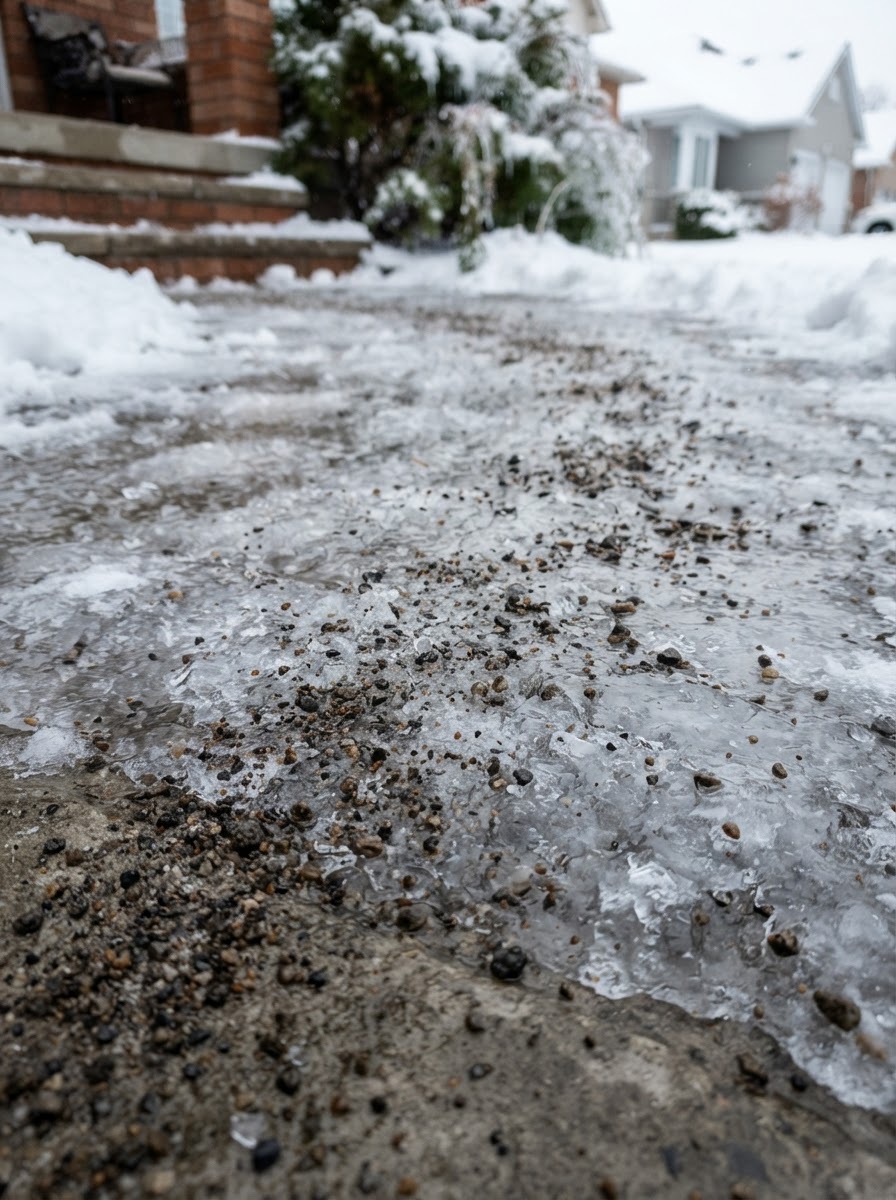
Sand is the dependable fallback when melting is not realistic. It does not depend on temperature, so it works on the coldest days when salt is ineffective. The trade-off is that it does nothing to reduce the ice itself — it simply gives tires and boots something to grip.
- Works at any temperature, including extreme cold when salt will not melt.
- Provides instant traction on shaded walkways and north-facing driveways.
- Does not damage concrete, pavers or nearby landscaping the way heavy salt can.
- Requires cleanup in spring — sand builds up in lawn edges, catch basins and paver joints.
For many Severn and Simcoe County properties with long, shaded or north-facing driveways, a salt-and-sand combination is the most practical approach: salt to melt where it can, sand to add grip where it cannot.
Not Sure Which Ice Control Method Fits Your Property?
Every driveway, walkway and parking lot handles winter differently. Northern Lakes Contracting can discuss your property's conditions and recommend salting, sanding or de-icing for the areas that matter most.
Liquid and Blended De-Icers Explained

Commercial de-icers are engineered to keep working where plain rock salt gives up. Common options include magnesium chloride, calcium chloride and blended products, each with a different effective temperature range and application method.
- Calcium chloride can melt ice at much lower temperatures than rock salt.
- Liquid de-icers can be applied as anti-icing pretreatment before a storm.
- Blends balance cost, melting speed and surface safety for commercial use.
- Some products are gentler on concrete and landscaping than straight sodium chloride.
The right choice depends on surface type, expected temperature, pedestrian traffic and budget. For commercial parking lots with high foot traffic, a de-icing plan is often the safer option than relying on rock salt alone.
Salting vs Sanding vs De-Icing Comparison
This is a general comparison of how each method behaves on an Ontario winter property — not a Northern Lakes Contracting price list.
| Factor | Rock Salt | Sand | De-Icer (Blended) |
|---|---|---|---|
| Melts ice? | Yes (above ~−9 °C) | No — traction only | Yes (lower temps) |
| Provides traction? | Minimal | Excellent | Minimal |
| Effective in extreme cold? | Limited | Yes | Yes |
| Cleanup needed in spring? | Light residue | Significant | Light residue |
| Surface impact | Can damage concrete/pavers | Low impact | Varies by product |
| Best use case | Melting on driveways | Grip on shaded ice | Commercial walkways |
When to Use Each Method on an Ontario Property
Most properties do not pick one method — they use each where it fits:
- Salt on the main driveway and entrance walk where pavement stays above −9 °C most days.
- Sand on shaded, north-facing or low-traffic areas where ice tends to persist.
- De-icer on commercial entry walkways and stairs where pedestrian safety is the priority.
- A salt-and-sand blend on longer Severn driveways where both melting and grip are needed.
The goal is matching the method to the surface, temperature and how the area is actually used — not applying one product everywhere and hoping for the best.
Freeze-Thaw, Refreeze and Ontario Winters
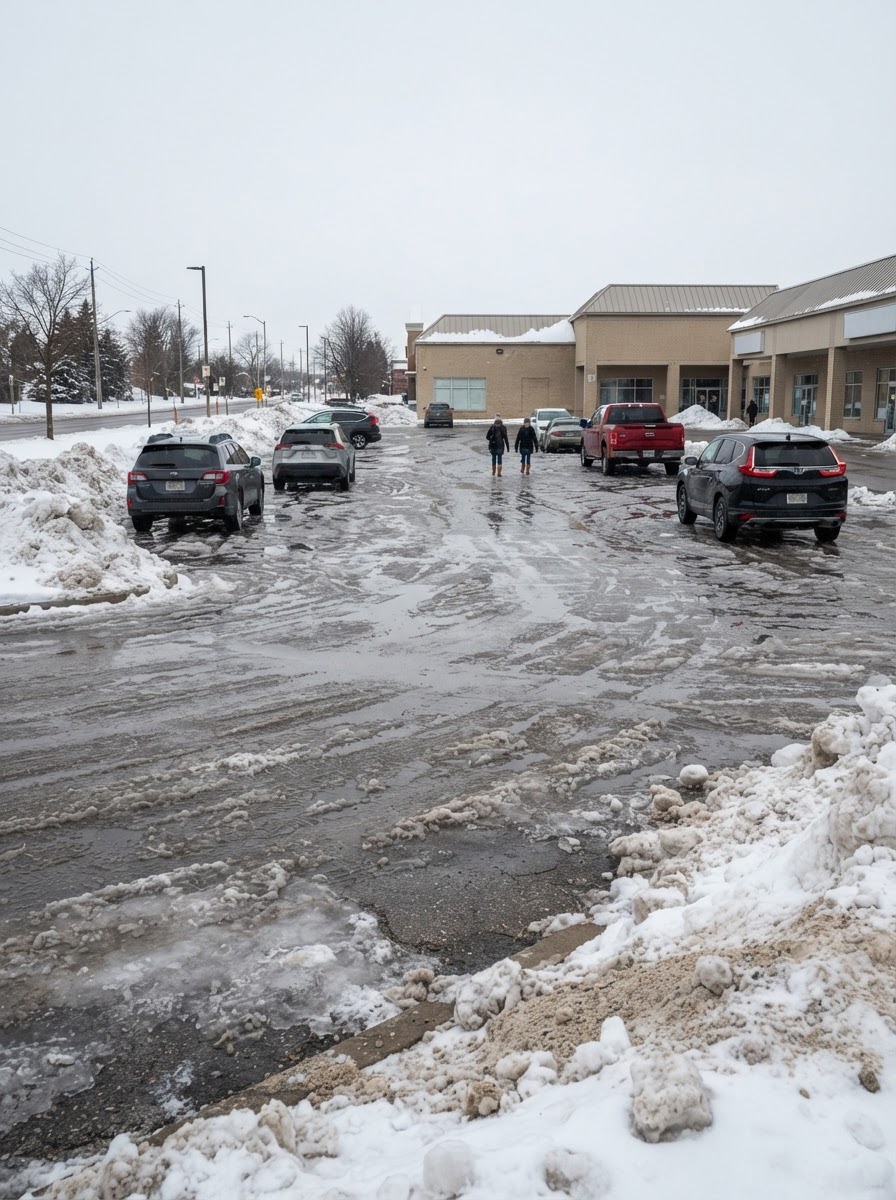
Ontario's freeze-thaw cycles are the real challenge. A walkway can melt during the day, run with water, and freeze solid again overnight. That refrozen layer is often slicker than the original snow. Salt that was applied earlier may have already washed away, leaving a fresh ice sheet with no treatment.
This is why timing matters. Applying salt or de-icer before a freeze event (anti-icing) can prevent the bond from forming in the first place, which is far more effective than trying to break an already-frozen surface. The Province of Ontario's de-icing guidelines provide official context on how municipalities and contractors are expected to manage snow and ice disposal responsibly.
For commercial properties, a documented ice management plan that addresses refreeze conditions is one of the most effective ways to reduce slip risk through the season.
Need a Smarter Winter Ice Plan?
Refreeze, freeze-thaw and shaded ice catch most property owners off guard. Northern Lakes Contracting can build a salting, sanding and de-icing routine around your Simcoe County property.
Protecting Concrete, Pavers and Asphalt Surfaces
Not every surface handles salt the same way. New concrete, sealed interlocking pavers and decorative walkways can all be affected by heavy or repeated salt use over a single winter.
- New concrete (under a year old) is especially vulnerable to salt scaling.
- Interlocking pavers can lose joint material faster when salt is over-applied.
- Sealed surfaces may be more resistant, but repeated heavy salt still takes a toll.
- Asphalt is generally more salt-tolerant but still benefits from measured application.
If your property has decorative or interlocking surfaces, it is worth reviewing your interlocking driveway winter prep before the season starts, so you are not applying more salt than those surfaces can handle.
Commercial Parking Lots and Walkway Strategy
On a commercial lot, the strategy usually combines all three methods. Salt or de-icer handles the high-traffic entrances and pedestrian routes, while sand keeps shaded corners and low-use areas walkable when melting is not realistic.
- Prioritize main entrances, stairs and accessible routes first.
- Use de-icer on walkways where pedestrian safety is the main concern.
- Add sand to low-traffic or shaded parking edges that stay icy.
- Plan re-application around refreeze windows, not just fresh snowfall.
A layered approach keeps a commercial property safer than any single product applied everywhere. You can read more about how this fits into a broader winter plan in our commercial snow removal contract guide.
Environmental and Runoff Considerations
Salt does not disappear when the ice melts — it runs off into lawns, garden beds and storm drains. Over time, heavy salt use can affect soil and nearby vegetation, which is one reason property owners increasingly pair it with sand rather than relying on salt alone.
- Sanding reduces the total salt volume needed through the season.
- De-icers can sometimes be applied at lower rates than rock salt for similar results.
- Targeted application on high-risk areas minimizes runoff into landscaping.
The environmental balance is another reason a combined, property-specific plan usually outperforms blanket salt coverage.
What Affects the Cost of Winter Ice Control
The cost of salting, sanding or de-icing a property depends on the surface area, how often service is needed, which products are used and how much foot or vehicle traffic the property handles. These are general factors only — not Northern Lakes Contracting pricing.
- Total surface area (driveway, walkways, parking lot).
- Number of service visits through the season.
- Product type: rock salt, sand, or a blended de-icer.
- Property type: residential driveway vs commercial lot.
- How quickly refreeze conditions require re-application.
- Site access and how much hand-clearing is required.
The most accurate way to understand cost is a site-specific assessment. For an overview of how pricing is built, our snow removal cost guide for Orillia explains the same factors in more detail.
Frequently Asked Questions
Does sand melt ice?
When should de-icer be applied?
What is the difference between salt and de-icer?
Is sand or salt better for a driveway?
Can salt damage my interlocking driveway?
How often should I salt my walkway?
Do I need de-icer if I already use salt?
Is sand bad for lawns?
What is the best ice control method for a commercial parking lot?
How do I get a salting or de-icing quote for my property?
Choose the Right Ice Control Method for Your Property
The best winter traction plan matches the method to the surface, temperature and how each area is used. Northern Lakes Contracting can review your Simcoe County property and build a salting, sanding and de-icing routine around the areas that matter most.