
Interlocking vs Concrete Driveways: Which is Best for Ontario?
When it's time to replace or upgrade your driveway in Ontario, property owners usually face a tough decision: poured concrete or interlocking pavers? While both options can look beautiful on day one, the harsh reality of Canadian winters will quickly reveal which material is truly built to last.
In Simcoe County and Muskoka, we experience extreme temperature fluctuations. We deal with heavy snow loads, deep freezes, rapid thaws, and intense summer heat. These environmental factors put immense stress on your home's hardscaping.
In this guide, we will break down the true cost, durability, maintenance requirements, and aesthetic value of interlocking stone versus poured concrete, helping you make the best long-term investment for your property.
1. The Enemy of Driveways: The Freeze-Thaw Cycle
To understand why driveways fail in Ontario, you must understand the freeze-thaw cycle.
During the day, snow melts and water seeps into the ground beneath your driveway. At night, the temperature drops below freezing. When water freezes, it expands by approximately 9%. This expansion exerts massive upward pressure on whatever is sitting above it (this is known as frost heave). When the ground thaws again, the ice melts, leaving a void. The heavy driveway then settles back down into that void.
This continuous lifting, shifting, and settling happens dozens of times every winter in places like Orillia and Muskoka.
2. How Poured Concrete Reacts to Ontario Winters
Poured concrete is a rigid, inflexible slab. When the ground beneath it shifts due to frost heave, the concrete cannot bend. It has no choice but to crack under the pressure.
Contractors attempt to control this by cutting "control joints" into the concrete, hoping the slab will crack in a straight line along the joint rather than jaggedly across the middle. However, it is an industry saying that there are only two types of concrete: concrete that has cracked, and concrete that is going to crack.
Furthermore, concrete is highly susceptible to salt damage. The road salt dripping off your car during winter (and the de-icing salt you apply) will eat away at the surface of poured concrete, leading to spalling, pitting, and a crumbling surface within just a few years.
3. How Interlocking Pavers React to Ontario Winters
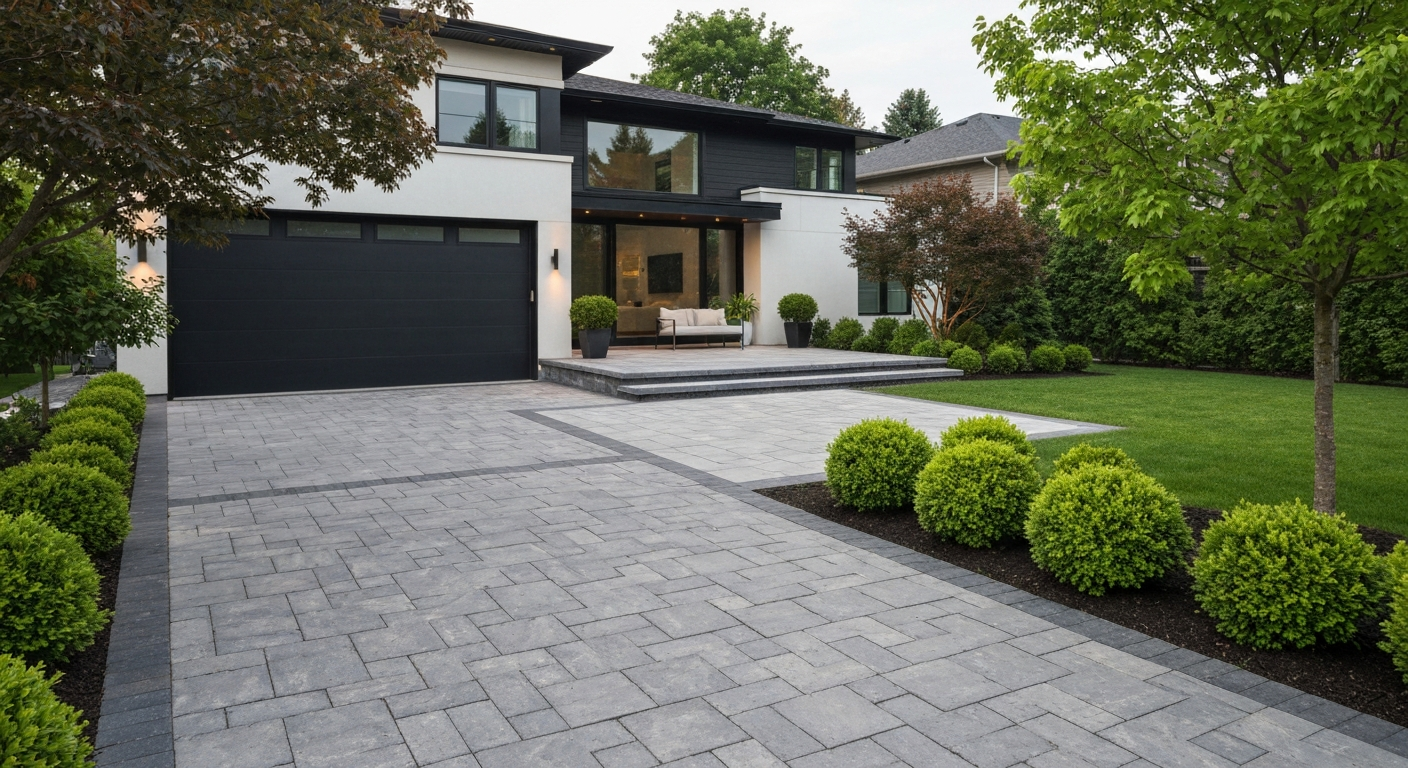
Interlocking stone driveways are fundamentally different. Instead of one massive, rigid slab, an interlocking driveway is essentially a flexible system made up of hundreds of individual high-density concrete pavers set on a carefully compacted aggregate base.
When the ground shifts during a freeze-thaw cycle, the individual pavers can flex, shift, and move slightly with the earth. Because the system is flexible, it does not crack under pressure. When the ground settles in the spring, the pavers settle right back into place.
Additionally, premium interlocking pavers (from brands like Permacon or Techo-Bloc) are manufactured in highly controlled environments. They are compressed under extreme pressure, making them significantly denser and stronger than poured-in-place concrete. This high density makes them vastly more resistant to salt damage and surface spalling.
4. The Repairability Factor
This is perhaps the biggest differentiator for homeowners considering the long-term cost of their driveway.
If a poured concrete driveway cracks, sinks, or gets stained by oil, your options are limited and expensive. You cannot easily patch concrete without it looking like a glaring, ugly patch. If a section sinks, you either have to live with it, pay for expensive mud-jacking, or rip out the entire driveway and start over.
If an interlocking driveway settles in one spot (perhaps due to a buried tree root rotting away), the repair is simple. A contractor can lift the affected pavers, add more base material, re-compact the area, and lay the exact same stones back down. The repair is completely invisible, fast, and inexpensive. If a paver gets stained by motor oil, you can simply lift that single stone out and replace it with a spare.
5. Aesthetic Value and Curb Appeal
While stamped concrete can mimic the look of stone, it still carries the risk of cracking and surface flaking. Once stamped concrete flakes, the uncolored grey concrete beneath is exposed, ruining the aesthetic.
Interlocking pavers offer unparalleled design flexibility. You can choose from hundreds of colors, textures, and shapes. You can incorporate contrasting borders, intricate patterns, and integrate the driveway seamlessly with your retaining walls, walkways, and front steps. A well-designed interlocking driveway instantly elevates the curb appeal and resale value of a premium home.
Tired of a Cracked Driveway?
Upgrade to a premium interlocking stone driveway built specifically for Ontario winters. Get a free 3D design to see the transformation before we build.
6. Installation Process Differences
Problem: Concrete installations are highly weather-dependent and require a massive curing time before you can drive on them.
Agitation: If a contractor pours concrete on a day that is too hot, too cold, or too wet, the structural integrity of the slab is permanently compromised from day one.
Solution: Interlocking pavers are manufactured in a climate-controlled facility. Once they are installed on your property, they are immediately ready for traffic. There is no curing time, no waiting, and the installation is far less susceptible to sudden weather changes.
7. Base Preparation Requirements
The secret to a driveway that lasts 30 years isn't the stone on top—it's the gravel underneath.
For interlocking driveways in Simcoe County, we excavate 12 to 18 inches to remove frost-susceptible soil. We install geotextile fabric and heavily compact layers of Granular 'A' gravel. This deep, free-draining base prevents water from pooling under the driveway, virtually eliminating the destructive force of frost heave. Concrete contractors often use a much shallower base, which is why their slabs crack so frequently.

8. Maintenance & Sealing
What is the real maintenance cost? Both concrete and pavers benefit from sealing, but interlocking stone requires less intensive upkeep.
Modern interlocking driveways use polymeric sand in the joints, which hardens like concrete to prevent weed growth and ant infestations. A simple sweep and a pressure wash every few years, along with a coat of protective sealer, will keep an interlocking driveway looking brand new for decades.
9. Permeability & Environment
Poured concrete is an impermeable surface. Rainwater rushes off it, overwhelming municipal storm drains and contributing to localized flooding.
Interlocking pavers (especially permeable variations) allow rainwater to naturally filter back into the groundwater system through the joints. This eco-friendly approach reduces runoff, prevents pooling water, and is increasingly favored by local Ontario municipalities.
10. Conclusion: The Clear Winner for Ontario
While poured concrete might have a slightly lower initial installation cost, interlocking stone is the clear winner for Ontario properties when you factor in longevity, repairability, salt resistance, and aesthetic value. An interlocking driveway, when installed correctly with a deep, properly compacted gravel base, is a permanent upgrade that will outlast and outperform concrete in our harsh climate.